Monsoon Roof Damage: 7 Signs You Need a Phoenix Roofer

In This Guide
The storm came through around seven. Forty minutes of wind, dust, and rain that sounded like gravel on the windows — and then it was gone, and the street was already steaming. The next morning you walk outside with your coffee and look up. Nothing on the lawn. No drips, no stains, nothing obviously out of place. The roof looks exactly like it did the day before. So you go to work and forget about it.
That is how most monsoon roof damage in the Valley gets missed. Not because homeowners are careless, but because the storm that damages your roof is almost never the storm that leaks it. Monsoon damage arrives in two acts. The first storm moves something — lifts a tile, breaks a shingle’s seal, pulls a strip of flashing loose, punches a hole in a coating. Nothing gets in, because the wind and the rain came from the same direction and the opening never faced the water. The second storm, eleven days later, hits from a different angle and finds that opening immediately.
By then you’re not looking at a roof repair. You’re looking at drywall, insulation, and whatever was underneath. This guide covers the seven signs that tell you your roof lost the first round — before the second one collects.
days in Arizona’s official monsoon season — June 15 through September 30. Damage from a June storm doesn’t sit quietly. It waits for the next one, and the next one is always coming.

Why Monsoon Damage Doesn’t Leak the Same Night
Understanding the two-act pattern is the whole game here, because it explains why “my ceiling is dry, so my roof is fine” is the single most expensive assumption a Valley homeowner makes each summer.
Act One: The Wind Moves Something
Monsoon wind doesn’t just push against your roof. It flows over it and creates lift — low pressure above the surface, ordinary pressure underneath — and that difference tries to peel roofing material upward, especially at edges, corners, ridgelines, and anywhere a piece already sits slightly proud. A tile slides half an inch out of position. A shingle tab that was sealed down by years of heat breaks its bond and settles back so flat you’d never spot it. A run of flashing at a wall or vent gets tugged loose at one end. A piece of windborne debris nicks a foam or flat roof’s coating.
None of that leaks. The roof is still covered. From the street it is identical to yesterday’s roof. But the system underneath — the underlayment, the seals, the layered overlaps that actually shed water — has a gap in it now.
Act Two: The Next Storm Finds the Opening
Here is the part Phoenix homeowners underestimate: monsoon storms are not an event, they’re a season. The National Weather Service defines Arizona’s monsoon as June 15 through September 30 — 108 days of repeated opportunity. The roof that took a hit in the first week of July is going to be tested again in ten days, and again after that, and again in August.
And these storms don’t repeat themselves. Wind direction shifts, rain intensity varies, some carry hail, some carry a wall of dust that sandblasts everything first. The opening that stayed dry during the first storm has a dozen more chances to face the water at exactly the wrong angle. When it finally does, wind-driven rain doesn’t trickle in — it gets forced in, sideways, under the material, into the underlayment and down to the decking.
The one-sentence version: The first storm opens the roof. A later storm uses it. The days in between are the only window where this is a small, simple, inexpensive repair — and in monsoon season that window is measured in days, not months.
Key Takeaways
- Monsoon damage rarely leaks the night it happens — the roof gets opened first and used later, often by a storm weeks afterward.
- Look for signs of displacement, not signs of water: pieces moved, pieces on the ground, granules in gutters, torn flashing, debris on the roof.
- Arizona’s monsoon season runs June 15 to September 30, so a roof opened in July faces months of additional storms before the season ends.
- A ceiling stain that dried out is not a resolved leak. It’s proof of an open path that the next storm will use again.
- Never climb up to check. Every sign in this guide is visible from the ground, a window, or inside the house.
- If you spot any of the seven signs, schedule a free roofing checkup within days — not at the end of the season.
The 7 Signs You Need a Roofer Now
You can catch all seven of these without a ladder. Walk the perimeter of the house the morning after a storm, look up at the roofline from across the street, glance at the gutters, and check your ceilings. That’s it — ten minutes, and it’s the highest-value ten minutes of your monsoon season.
1 Roofing Pieces on the Ground
Tile fragments in the gravel. A whole tile in the oleanders. Shingles in the side yard, or in your neighbor’s. This is the least ambiguous sign there is, and it’s the one people most often talk themselves out of — “it’s just one tile.”
It is never just one tile. A piece on the ground means there’s a bare spot on the roof, and it also means the wind found enough purchase to move something, which means the pieces still up there took the same force. Bag what you find and leave it for the roofer; it tells them what came from where.
2 A Break in the Pattern of the Roof
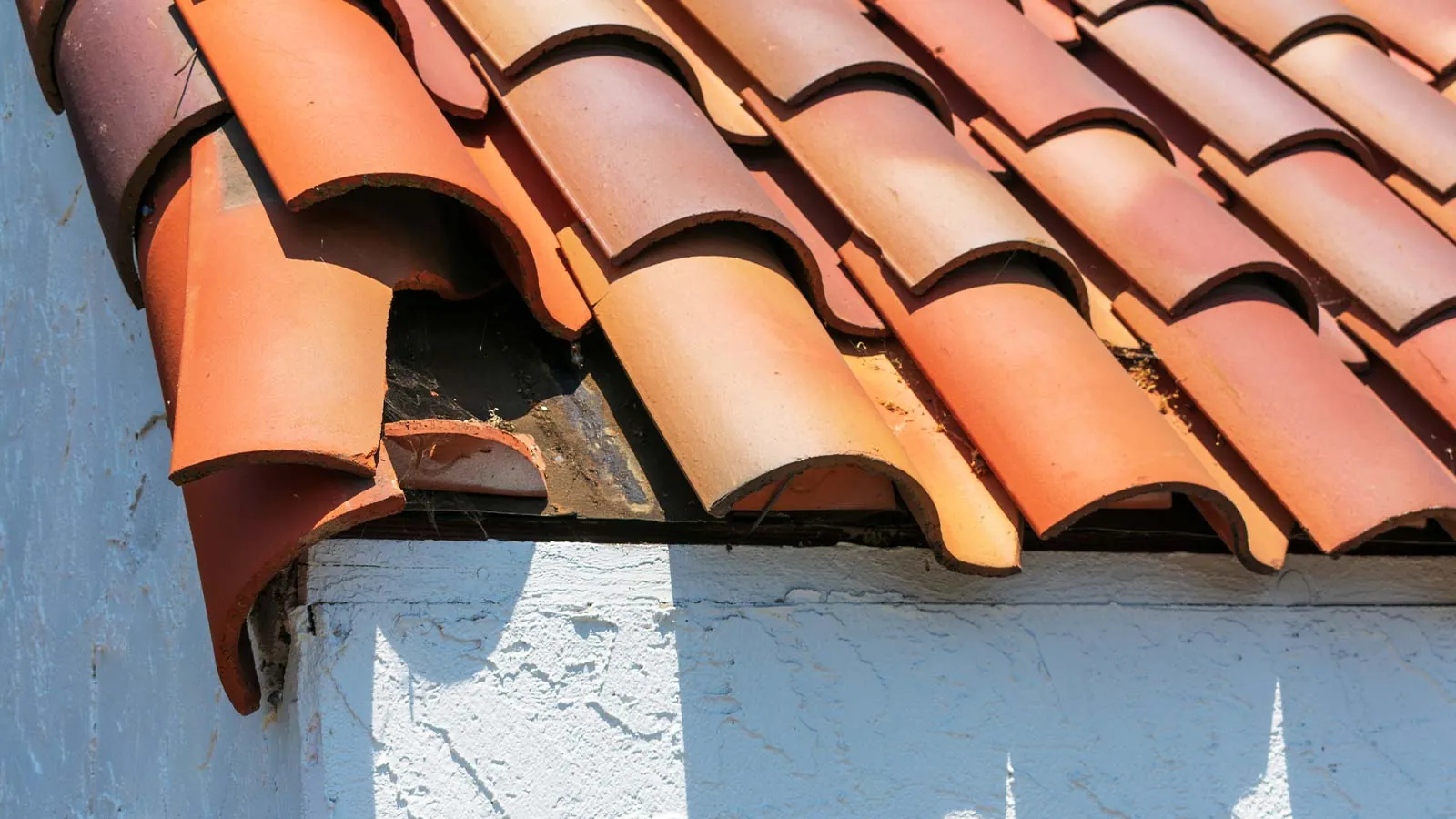
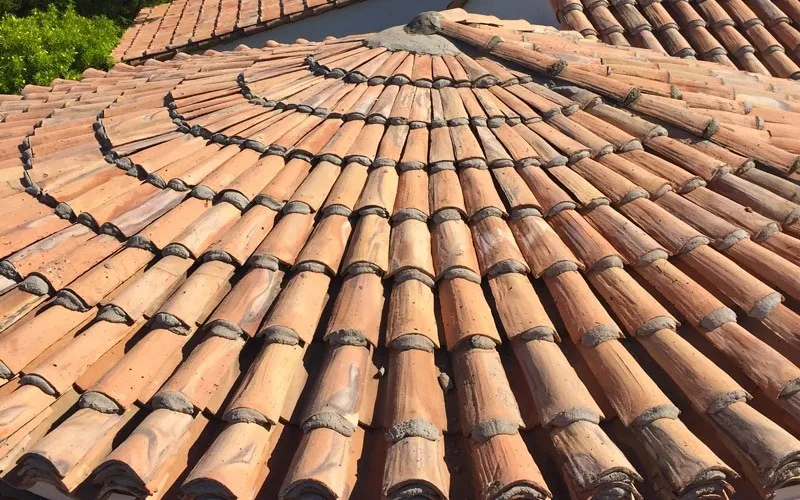
Stand across the street and look at your roof the way you’d look at a bookshelf — you’re checking for straight lines. Tile roofs read as clean, even courses; a tile that slipped, lifted, or rotated shows up as a wobble in an otherwise regular line. On a shingle roof, look for a curled edge, a raised corner, or a course that suddenly looks darker or shinier than the ones around it.
Everything is still there — that’s why this one gets missed. But a displaced piece is no longer overlapping the way it was engineered to, and the layer beneath it is now exposed to sun and the next round of rain.
3 Grit and Granules in the Gutters
Check the bottom of a downspout or the splash zone where it discharges. If you’re finding what looks like coarse dark sand after a storm, those are the protective granules off your shingles — the layer that shields the asphalt underneath from UV. Storm wind and windborne debris strip them, and once they’re gone, that section of shingle starts baking.
A few granules over years is normal wear. A visible pile after one storm is not. This is the sign that most often precedes a leak by a full season, which is exactly why it’s worth catching now — and it frequently shows up alongside the other signs of worn shingles on a Valley roof.
4 Flashing That’s Lifted, Torn, or Missing
Flashing is the thin sheeting that seals the roof’s most vulnerable seams: where the roof meets a wall, around vents and pipes, at skylights, in valleys where two slopes drain together. It’s also the first thing monsoon wind grabs, because it has edges.
From the ground or an upstairs window, look for anything at those junctions that’s peeled up, bent back, wrinkled, or simply gone. Flashing failures are responsible for a disproportionate share of Valley roof leaks precisely because they sit at the spots where water is already being concentrated. Loose flashing plus a storm from the wrong direction is close to a guaranteed leak.
5 Water Stains, Bubbled Paint, or a Musty Smell Inside
Your house tells you about your roof before your roof does. Walk the interior with the lights off and the blinds open, and look at ceilings and the tops of walls: a faint tan ring, a patch that’s slightly darker, paint that’s bubbled or gone chalky, a corner of drywall tape lifting. If you have an attic and safe access, look for damp insulation, dark streaks on the decking, or daylight where there shouldn’t be any.
Then use your nose. A musty, closed-up smell in one room, or in a closet on an exterior wall, often shows up before any stain does. Any of this means water has already made the trip from outside to inside — and that path is still open. Leaking roof repair is dramatically simpler when it’s caught at the stain stage instead of the sagging stage.
6 Gutters Overflowing, Sagging, or Packed With Debris
During the next rain, watch where the water actually goes. If it’s spilling over the front edge of the gutter, sheeting down the fascia, or shooting out at a joint, the gutter isn’t draining — it’s dammed with monsoon debris, or it got knocked out of pitch by wind or a branch.
That matters more than it sounds. Backed-up gutters push water up under the bottom courses of tile or shingle, straight into the underlayment, which is the one place your roof has no defense against water arriving from below. It also dumps water against your fascia and walls. If it’s been a while, KY-KO’s guide to cleaning your gutters walks through doing it safely.
7 Water Still Standing 48 Hours After the Rain
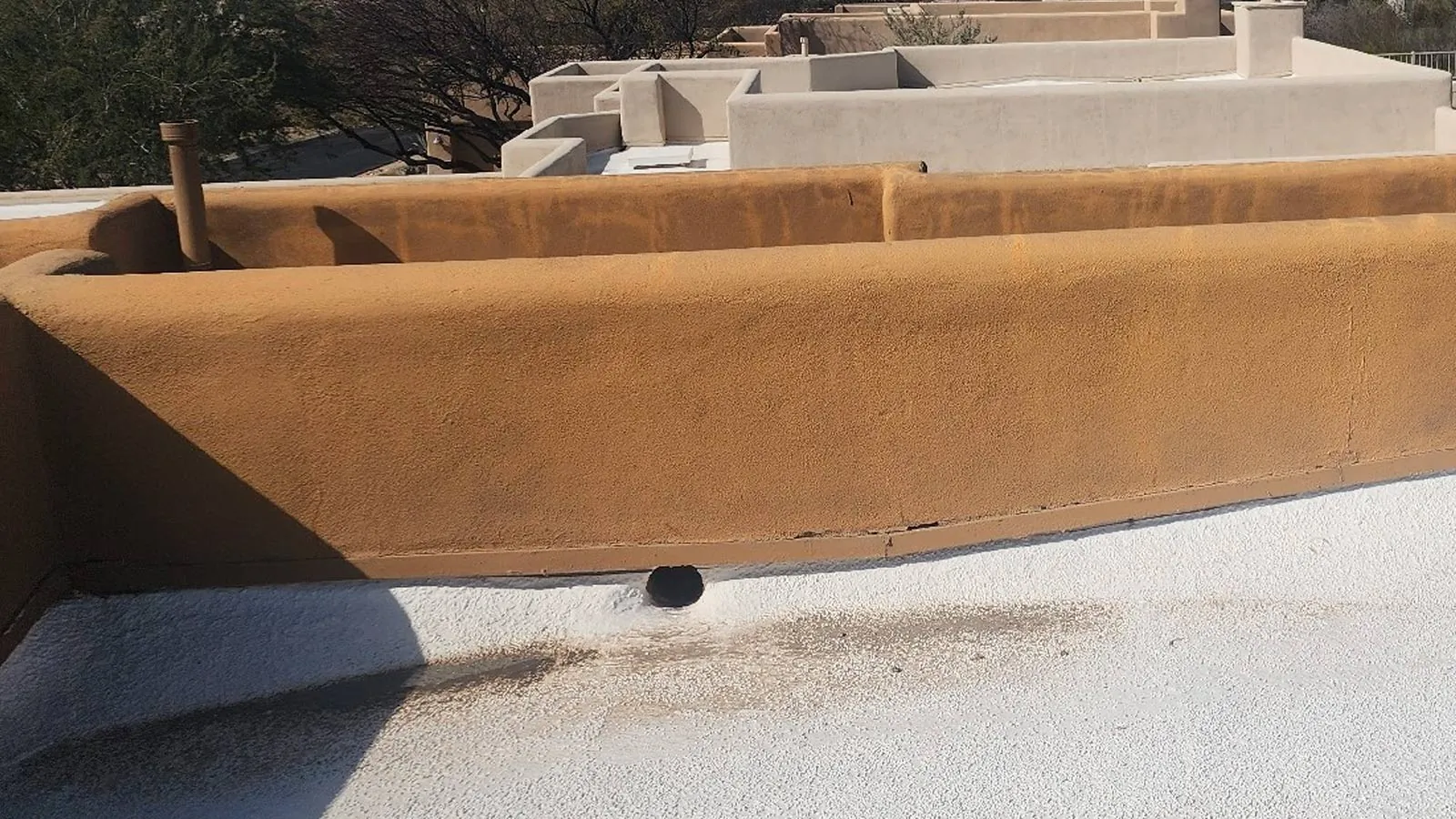
This one is for flat roofs and foam roofs, and it’s the reason those homeowners can’t rely on the from-the-street check. If you can see part of the roof from a second-story window or a neighboring vantage point, look for water that’s still there two days after the storm — or for the dirty rings and residue it leaves behind after it evaporates.
Phoenix heat dries a properly draining flat roof fast. Water that lingers means a drain or scupper clogged with storm debris, or a low spot that’s begun to sag. Ponding water is heavy, it accelerates coating breakdown, and it will find any flaw the storm left behind. If your foam roof was already overdue for attention, the storm just moved up your timeline — KY-KO covers the underlying issue in why foam roofs fail early in Phoenix.
Damage That Can’t Wait Until Monday
Most of what’s above wants a call within a few days. The list below is different. These mean the roof is open right now, or water is actively moving through your home, and the response window is hours.
- A visible hole, gap, or exposed section — If you can see underlayment, decking, or daylight through the roof from below, there’s nothing between your home and the next downpour.
- A limb, trunk, or large debris resting on the roof — The weight is a problem and so is whatever it did on impact. Don’t try to remove it yourself; that’s how a cracked tile becomes a foot through the ceiling.
- Roofing peeled back or a section missing — Wind that took a whole section has already compromised the material around the edges of that section too.
- Active dripping during or after rain — Put a bucket under it, move what’s below, and call. Water tracks along framing and rarely enters directly above where it lands.
- A ceiling that’s sagging, bulging, or heavy-looking — That’s pooled water sitting on drywall. It’s a collapse risk. Get people out of the room and call.
- A soft, spongy, or visibly dipped area on a flat roof — Saturated decking or insulation. It doesn’t dry out on its own and it won’t survive the rest of the season.
For any of these, a Phoenix roof repair team can usually stabilize the roof quickly and keep a bad night from turning into a rebuilt ceiling. If the damage turns out to be extensive enough that repair isn’t the right answer, KY-KO also handles full roof replacement — but that determination comes after a roofer has actually been up there, not before.
What the Storm Does to Your Roof Type
The seven signs apply to every home in the Valley, but what the wind actually breaks depends on what’s on top of your house. Knowing your roof’s specific failure mode tells you where to look first.
Tile Roofs
Tiles are armor, and they’re heavy — but they’re individual pieces, and wind lifts them at the edges. A tile that slips or rotates leaves the underlayment beneath it exposed. Since the underlayment is the actual waterproofing layer, one moved tile is a real breach, not a cosmetic one. More on that in signs of tile roof damage after monsoons.
Shingle Roofs
Shingles seal themselves down with heat over time. Monsoon wind breaks that bond, and the tab drops back into place looking untouched while no longer being watertight. Windborne dust and debris also strip protective granules, which shortens the life of everything it touches.
Foam & Flat Roofs
These rarely lose material to wind — they lose drainage. Storm debris clogs drains and scuppers, and water sits. Flying debris can also nick or puncture the coating, letting water reach the layer that was never meant to see it. You can’t check these from the ground, which is the whole problem.
Every Roof: Flashing & Drainage
Regardless of material, the seams and the drainage are where storms win. Flashing has edges for wind to grab, and gutters fill with the exact debris a monsoon delivers. These two account for a large share of the leaks that show up after Valley storms.
Commercial and multi-family properties follow the same logic across a lot more square footage — and with far more rooftop equipment, penetrations, and drains for a storm to disrupt. KY-KO’s commercial roofing team handles post-storm assessments for buildings of every size in the metro.
Why “It Stopped Leaking” Isn’t Good News
There’s a specific trap that only exists in a desert climate, and it catches Valley homeowners every single monsoon season.
Somewhere else in the country, a leak announces itself and keeps announcing itself. It’s damp, it stays damp, and it’s obviously a problem until someone fixes it. Here, the storm passes, the sun comes out, and within a day or two the temperature is back above 100°F. Whatever got in evaporates. The stain stops spreading. The drip stops dripping. The room stops smelling.
So the problem appears to have solved itself. It didn’t. Nothing about the roof changed — the water simply ran out. The path from outside to inside is exactly as open as it was during the storm, and it will be used again in ten days when the next cell rolls over the Valley. Meanwhile, that repeated wet-dry cycle is quietly working on your decking and framing, and each round soaks a slightly larger area before the heat catches up.
Dry doesn’t mean fixed. A leak that stopped on its own in Phoenix has not been repaired — it’s just been paused by the weather. Treat a dry stain the way you’d treat a wet one, because the roof does.
This is also why homeowners are so often blindsided by the scope of the eventual repair. The leak they finally call about in September isn’t a September problem. It’s a June problem that has been re-wetting the same joists every ten days for three months.
What to Do in the First 48 Hours
Here’s the whole post-storm routine. It takes about fifteen minutes and requires nothing but your eyes and your phone.
Walk the Perimeter, Look Up, Look Down
Circle the house. Look at the ground for tile shards, shingles, granule piles, and torn flashing. Then look up at the roofline from a distance — across the street is better than standing at the wall, because you can see the plane of the roof. You’re checking for a break in the pattern, not for a hole.
Check the Inside Before You Check the Outside Again
Ceilings, the tops of exterior walls, closets on outside walls, and the attic if you have safe access. Look for stains, bubbling, discoloration, damp insulation, or daylight. Trust your nose on musty smells — it’s often the earliest signal you get.
Document Everything, Dated
Photos of debris on the ground, of anything visibly out of place, of interior stains, of standing water. Same-day photos with timestamps are worth far more than a memory of what it looked like. If you end up in a claims conversation, this is the record. KY-KO’s roofing insurance page covers how they work with homeowners on that process.
Schedule the Checkup — Don’t Wait for Proof
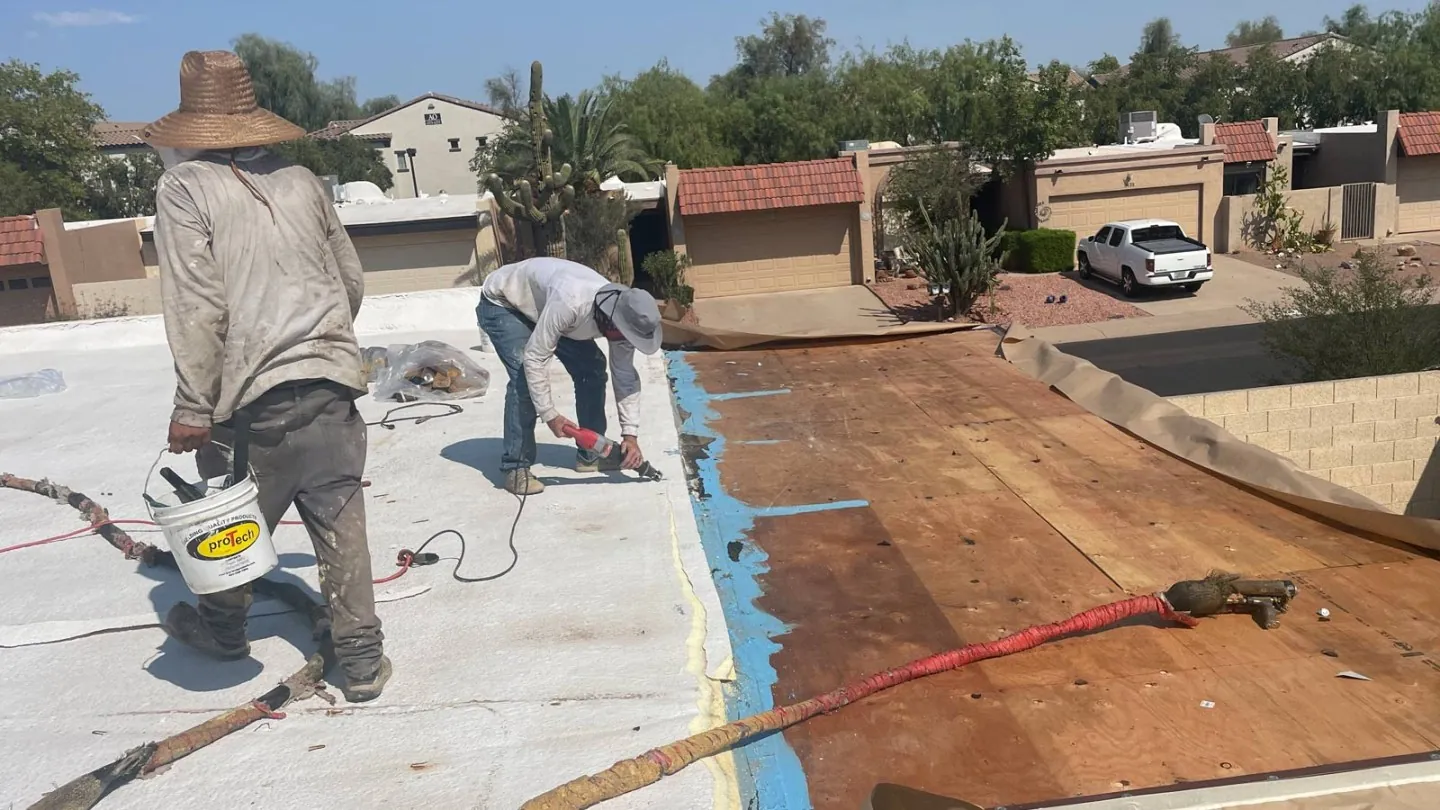
You are not trying to confirm damage before calling. That’s the roofer’s job, and it’s free. A licensed KY-KO roofer gets up on the roof, inspects the material, seals, flashing, penetrations, and drainage up close, then comes down and tells you exactly what they found. If nothing’s wrong, you’ve lost nothing but an hour.
- Never get on the roof yourself. Tile cracks under foot traffic — you can create the leak you were checking for. Storm-softened decking gives way without warning. Dust and residue make surfaces slick, and Valley roof surfaces run brutally hot for most of the day. There is no sign in this entire guide that requires you to be up there.
The Between-Storm Window
Timing is the whole argument of this article, so it’s worth making it plainly.
During the Season: Days, Not Weeks
From mid-June through September, your roof is not waiting for one more storm — it’s waiting for a dozen. That changes the math on “I’ll deal with it later.” Later is another storm. The gap between two monsoon cells is the cheapest repair window you will ever get, because it’s the only time the damage is still small, still dry, and still confined to the roof. Once water is inside, you’ve added drywall, paint, insulation, and possibly framing to a job that started as a handful of tiles.
After the Season: Don’t Skip the Postmortem
When the season winds down at the end of September, get the roof looked at even if nothing dramatic happened. This is the checkup that catches the damage that never leaked — the shingle that unsealed in July, the flashing that’s been hanging on since August, the underlayment that’s been exposed under a slipped tile for two months. Fall is a good working window in the Valley: temperatures are reasonable, crews aren’t stretched, and repairs get made calmly instead of urgently.
Two calls a year beats one emergency. One checkup before June 15, one after September 30. That rhythm catches nearly everything a Phoenix monsoon does to a roof, in the seasons where fixing it is straightforward.
KY-KO serves homes and businesses across the Valley — Mesa, Tempe, Chandler, Gilbert, Peoria, Glendale, Scottsdale, and the surrounding communities listed on the service areas page. All roofing work is backed by the Owner’s Pride Guarantee, a commitment to using only UL-certified materials on every project.
If storm repairs land at an inconvenient moment — and monsoon damage rarely asks about your calendar — KY-KO offers financing options with approved credit. Current details are available on their financing page.
Frequently Asked Questions
How do I know if a monsoon damaged my roof if it isn’t leaking?
Most monsoon damage does not leak the night it happens. Wind lifts, shifts, or cracks something on the roof, and the opening it leaves does not let water in until a later storm hits it from the right angle. That is why the signs to look for are displacement signs, not water signs: tiles or shingles out of alignment, pieces on the ground, granules in the gutters, torn flashing, or debris on the roof. If any of those are there, the roof is already open even if the ceiling is dry.
What are the signs I need a Phoenix roofer immediately after a monsoon?
Call right away if you see a visible gap or hole in the roof surface, a tree limb or large debris resting on the roof, a section of roofing peeled back or missing, active dripping inside, a sagging ceiling or a bulge in drywall, or standing water still sitting on a flat roof more than 48 hours after the rain stopped. These mean the roof is open or already taking on water, and the next storm is usually only days away during monsoon season.
Should I get on my roof to check for storm damage myself?
No. Walking a roof after a storm is dangerous for you and for the roof. Tile cracks under foot traffic, storm-softened decking can give way, and wet or dusty surfaces are slick. Every sign worth catching can be spotted from the ground, from a window, or from inside the house. Leave the up-close inspection to a licensed roofer who is equipped to do it safely.
How long should I wait to call a roofer after a monsoon storm?
Don’t wait for the next storm to prove there is a problem. Arizona’s monsoon season officially runs from June 15 through September 30, so a roof that gets opened in July has months of storms still ahead of it. If you have spotted any of the warning signs, schedule a checkup within days, not weeks. Repairs made between storms are far simpler than repairs made after water is inside the house.
Does a small water stain on the ceiling mean my roof is leaking?
It means water got in at some point, yes. In Phoenix the leak itself is often long dry by the time you notice the stain, because desert heat evaporates the moisture quickly. A dry stain is not proof the problem resolved; it is proof there is a path from outside to inside. That path is still there, and the next storm will use it. Any new stain, ring, bubbled paint, or musty smell is worth a professional look.
Is monsoon roof damage covered by homeowners insurance?
Sudden storm damage is often covered while long-term wear and deferred maintenance generally is not, but coverage depends entirely on your specific policy. Document what you can see with dated photos, keep any repair records, and read your policy or speak with your carrier about what applies. KY-KO works with homeowners on insurance-related roofing claims and can provide a professional assessment of the damage found on your roof.
What does a free post-storm roofing checkup include?
A licensed KY-KO roofer gets up on the roof and inspects it up close, checking roofing material, underlayment exposure, flashing, seals, penetrations, drainage, and gutters for storm damage. They come back down and go over exactly what they found with you, along with a recommendation and an estimate if repairs are needed. It’s free, there’s no obligation, and it’s available throughout the Phoenix metro area.
When is monsoon season in Phoenix, Arizona?
Arizona’s monsoon season officially runs from June 15 through September 30 each year, about 108 days. Storm activity is typically heaviest from July into early September. Because storms arrive repeatedly across that window rather than once, damage from an early storm rarely stays isolated. The roof gets tested again and again until the season ends.
Find the Damage Before the Next Storm Does
KY-KO Roofing has been pulling Valley roofs back together after monsoon storms since 1994. Schedule a free roofing checkup — a licensed roofer will get up there, find what the storm left behind, and tell you exactly where you stand. No obligation, no pressure.
Schedule My Free Checkup Explore Roof RepairGet a free roofing checkup.
A licensed KY-KO roofer inspects your roof, documents anything the desert threw at it, and gives you a straight answer — repair, recoat, or replace.